Encoding EAN 13:
Cette page en Français 
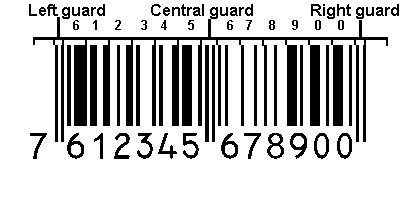
An EAN-13 barcode has the following physical structure:
- Left guard bars, or start sentinel, encoded as 101.
- The second character of the number system code, encoded as described below.
- The five characters of the Manufacturer Code, encoded as described below.
- Center guard pattern, encoded as 01010
- The five characters of the product code, encoded as right-hand characters, described below.
- Check digit, encoded as a right-hand character, described below.
- Right guard bars, or end sentinel, encoded as 101.
The characters that are encoded to the left of the center guard pattern are
considered the "left hand side" of the symbol whereas all
characters encoded to the right of the center guard pattern are considered
the "right hand side" of the symbol.
The first character of the EAN-13 number system code (i.e., the first digit of
the EAN-13 value) is encoded in the parity of the characters of the
left-hand side of the symbol. That is to say, the value of the first
character of the EAN-13 value determines the parity with which each of the
characters in the left-hand side of the barcode will be encoded from the
following table.
EAN Character Set Encoding Table:
This table indicates how to encode each digit of an EAN-13 barcode depending on
which half (left or right) of the barcode the digit is found in. In the
case of a left-hand digit, the encoding (odd or even parity) is based on
the value of the first digit of the number system code (see parity
encoding table below).
| Digit |
Left-Hand Encoding |
Right-Hand Encoding |
| Odd Parity (Set A) |
Even Parity (Set B) |
Set C |
| 0 |
0001101 |
0100111 |
1110010 |
| 1 |
0011001 |
0110011 |
1100110 |
| 2 |
0010011 |
0011011 |
1101100 |
| 3 |
0111101 |
0100001 |
1000010 |
| 4 |
0100011 |
0011101 |
1011100 |
| 5 |
0110001 |
0111001 |
1001110 |
| 6 |
0101111 |
0000101 |
1010000 |
| 7 |
0111011 |
0010001 |
1000100 |
| 8 |
0110111 |
0001001 |
1001000 |
| 9 |
0001011 |
0010111 |
1110100 |
NOTE: For
"left-hand encoding", odd and even parity is often
referred to as "character set A" (odd) and "character set
B" (even).
Observations:
- An EAN-13 character is represented in 7
elements consisting of 2
bars and 2
spaces.
No bar or space may be longer than 4 elements.
The only exception to this rule is the left and right guard bars (3
elements each) and the center guard bar (5 elements long).
- All characters in the left-hand side of the barcode always start with a 0
(space) while all characters in the right-hand side of the barcode
always start with a 1 (bar).
- The "right-hand" encoding pattern is exactly the same as the
"left-hand odd" encoding pattern, but with 1's changed to
0's, and 0's changed to 1's.
- The "left-hand even" encoding pattern is based on the "left-hand
odd" encoding pattern. To arrive at the even encoding, work from
the left encoding and do the following:
1) Change all the 1's to 0's and 0's to 1.;
2) Read the resulting encoding in reverse order (from right to left).
The result is the "left-hand even" encoding pattern.
EAN Parity Encoding Table:
The following table indicates the parity with which each character in the
left-hand side of the barcode should be encoded.
The parity is based on the first digit of the EAN-13 value.
For example, our EAN-13 is 761234567890.
In this case, the first digit of the number system
code is the first digit 7
, so the parity would be based on
the number 7 in the following table:
1st Number
System Digit |
Parity to encode with |
2nd Number
System Digit |
Manufacturer Code Characters |
| 1 |
2 |
3 |
4 |
5 |
| 0 (UPC-A) |
Odd |
Odd |
Odd |
Odd |
Odd |
Odd |
| 1 |
Odd |
Odd |
Even |
Odd |
Even |
Even |
| 2 |
Odd |
Odd |
Even |
Even |
Odd |
Even |
| 3 |
Odd |
Odd |
Even |
Even |
Even |
Odd |
| 4 |
Odd |
Even |
Odd |
Odd |
Even |
Even |
| 5 |
Odd |
Even |
Even |
Odd |
Odd |
Even |
| 6 |
Odd |
Even |
Even |
Even |
Odd |
Odd |
| 7 |
Odd |
Even |
Odd |
Even |
Odd |
Even |
| 8 |
Odd |
Even |
Odd |
Even |
Even |
Odd |
| 9 |
Odd |
Even |
Even |
Odd |
Even |
Odd |
Observation:
- The second number system digit is always encoded with odd parity.
- A UPC-A barcode always has a first number system digit of zero, and
therefore uses exclusively odd parity.
In fact, any EAN-13 symbol
which has a first number system digit of 0 is actually an UPC-A symbol,
not an EAN-13 symbol.
- All EAN-13 symbols (that have a first number system digit that is non-zero)
always have three left-hand characters that are encoded using even
parity and two that are encoded using odd parity.
Encoding Example:
This example will encode the EAN-13 barcode which represents the value:
7612345678900
- Number System 76,
- Manufacturer Code 12345,
- Product Code 67890,
- Check Digit is 0.
The first digit of the number system is 7.
Consulting the parity encoding
table for the digit 7,
we find that the parity for the second number system digit and the
manufacturer code should follow the pattern:
Odd Even Odd Even Odd Even.
That means:
- the second number system digit will be encoded from the left-hand
odd parity table,
- the first digit of the manufacturer code will be encoded with left-hand
even parity, etc.
We can now start encoding our barcode with the following steps:
| Digit name |
Numeric Value |
Encoded with |
Binary |
| Left Guard |
- |
- |
101 |
| 2nd Number System |
6 |
Odd |
0101111 |
| 1st Manufacturer |
1 |
Even |
0110011 |
| 2nd Manufacturer |
2 |
Odd |
0010011 |
| 3rd Manufacturer |
3 |
Even |
0100001 |
| 4th Manufacturer |
4 |
Odd |
0100011 |
| 5th Manufacturer |
5 |
Even |
0111001 |
| Central Guard |
- |
- |
01010 |
| 1st Product Code |
6 |
C |
1010000 |
| 2nd Product Code |
7 |
C |
1000100 |
| 3rd Product Code |
8 |
C |
1001000 |
| 4th Product Code |
9 |
C |
1110100 |
| 5th Product Code |
0 |
C |
1110010 |
| Check Digit |
0 |
C |
1110010 |
| Right Guard |
- |
- |
101 |
The barcode is then constructed by simply concatenating all the strings together.
10101011110110011001001101000010100011011100101010101000010001001001000111010011100101110010101

1
represents a bar and 0
represents a space.
Thus if we convert this string of numbers to their graphical
representation we end up with the following barcode:
Informations Gomaro s.a.
 Annexe : codes à barres